The Great Wave off Kanagawa
The Great Wave off Kanagawa (Japanese: 神奈川沖浪裏, Hepburn: Kanagawa-oki Nami Ura, lit. 'Under the Wave off Kanagawa') is a woodblock print by Japanese ukiyo-e artist Hokusai, created in late 1831 during the Edo period of Japanese history. The print depicts three boats moving through a storm-tossed sea, with a large wave forming a spiral in the centre and Mount Fuji visible in the background.
The print is Hokusai's best-known work and the first in his series Thirty-six Views of Mount Fuji, in which the use of Prussian blue revolutionized Japanese prints. The composition of The Great Wave is a synthesis of traditional Japanese prints and use of graphical perspective developed in Europe, and earned him immediate success in Japan and later in Europe, where Hokusai's art inspired works by the Impressionists. Several museums throughout the world hold copies of The Great Wave, many of which came from 19th-century private collections of Japanese prints.
The Great Wave off Kanagawa has been described as "possibly the most reproduced image in the history of all art", as well as being a contender for the "most famous artwork in Japanese history". It has influenced several notable artists and musicians, including Vincent van Gogh, Claude Debussy, Claude Monet, and Hiroshige.
Context
Ukiyo-e art
Ukiyo-e is a Japanese printmaking technique which flourished in the 17th through 19th centuries. Its artists produced woodblock prints and paintings of subjects including female beauties kabuki actors and sumo wrestlers scenes from history and folk tales travel scenes and landscapes Japanese flora and fauna and erotica. The term ukiyo-e (浮世絵) translates as "picture[s] of the floating world".
After Edo (now Tokyo) became the seat of the ruling Tokugawa shogunate in 1603, the chōnin class of merchants, craftsmen, and workers benefited most from the city's rapid economic growth, and began to indulge in and patronise the entertainment of kabuki theatre, geisha, and courtesans of the pleasure districts the term ukiyo ("floating world") came to describe this hedonistic lifestyle. Printed or painted ukiyo-e works were popular with the chōnin class, who had become wealthy enough to afford to decorate their homes with them.
The earliest ukiyo-e works, Hishikawa Moronobu's paintings and monochromatic prints of women, emerged in the 1670s. Colour prints were introduced gradually, and at first were only used for special commissions. By the 1740s, artists such as Okumura Masanobu used multiple woodblocks to print areas of colour. In the 1760s, the success of Suzuki Harunobu's "brocade prints" led to full-colour production becoming standard, with ten or more blocks used to create each print. Some ukiyo-e artists specialized in creating paintings, but most works were prints. Artists rarely carved their own woodblocks production was divided between the artist, who designed the prints the carver, who cut the woodblocks the printer, who inked and pressed the woodblocks onto hand-made paper and the publisher who financed, promoted, and distributed the works. As printing was done by hand, printers were able to achieve effects impractical with machines, such as the blending or gradation of colours on the printing block.
Artist
Katsushika Hokusai was born in Katsushika, Japan, in 1760 in a district east of Edo. He was the son of a shogun mirrormaker, and at the age of 14, he was named Tokitarō. As Hokusai was never recognised as an heir, it is likely his mother was a concubine.
Hokusai began painting when he was six years old, and when he was twelve his father sent him to work in a bookstore. At sixteen, he became an engraver's apprentice, which he remained for three years while also beginning to create his own illustrations. At eighteen, Hokusai was accepted as an apprentice to artist Katsukawa Shunshō, one of the greatest ukiyo-e artists of his time. When Shunshō died in 1793, Hokusai studied Japanese and Chinese styles, as well as some Dutch and French paintings on his own. In 1800, he published Famous Views of the Eastern Capital and Eight Views of Edo, and began to accept trainees. During this period he began to use the name Hokusai; during his life, he would use more than 30 pseudonyms.
In 1804, Hokusai rose to prominence when he created a 240-square-metre (2,600 sq ft) drawing of a Buddhist monk named Daruma for a festival in Tokyo.[11] Due to his precarious financial situation, in 1812, he published Quick Lessons in Simplified Drawing, and began to travel to Nagoya and Kyoto to recruit more students. In 1814, he published the first of 15 manga; volumes of sketches of subjects that interested him, such as people, animals, and Buddha. He published his famous series Thirty-six Views of Mount Fuji in the late 1820s; it was so popular he later had to add ten more prints. Hokusai died in 1849 at the age of 89.
According to Calza (2003), years before his death Hokusai stated:
From the age of six, I had a passion for copying the form of things and since the age of fifty I have published many drawings, yet of all I drew by my seventieth year there is nothing worth taking into account. At seventy-three years I partly understood the structure of animals, birds, insects and fishes, and the life of grasses and plants. And so, at eighty-six I shall progress further; at ninety I shall even further penetrate their secret meaning, and by one hundred I shall perhaps truly have reached the level of the marvellous and divine. When I am one hundred and ten, each dot, each line will possess a life of its own.
Description
The Great Wave off Kanagawa is a landscape-format yoko-e print that was produced in an ōban size of 25 cm × 37 cm (9.8 in × 14.6 in). The landscape is composed of three elements: a stormy sea, three boats, and a mountain. The artist's signature is visible in the upper left-hand corner.
Mountain
In the background is Mount Fuji and its snow-capped summit. Mount Fuji is the central figure of the Thirty-six Views of Mount Fuji series, which depicts the mountain from different angles. In The Great Wave off Kanagawa, Mount Fuji is depicted in blue with white highlights in a similar way to the wave in the foreground. The dark colour surrounding the mountain appears to indicate the painting is set in the early morning, with the sun rising from the viewer's vantage point and beginning to illuminate the snowy peak. There are cumulonimbus clouds between the mountain and the viewer; although these clouds typically indicate a storm, there is no rain on Fuji or in the main scene.
Boats
The scene shows three oshiokuri-bune, fast barges that were used to transport live fish from the Izu and Bōsō peninsulas to markets in Edo Bay. According to analysis by Cartwright and Nakamura (2009), the boats are located in Edo (Tokyo) Bay off Yokohama in present-day Kanagawa Prefecture, with Edo to the north and Mount Fuji to the west. The boats are facing south, likely to Sagami Bay to collect a cargo of fish for sale in Edo.[24] Each boat has eight rowers who are holding their oars. At the front of each boat are two more relief crew members; 30 men are represented in the picture but only 22 are visible. The size of the wave can be approximated using the boats as a reference: the oshiokuri-bune were generally between 12 and 15 metres (39 and 49 ft) long. Taking into account Hokusai reduced the vertical scale by 30%, the wave is between 10 and 12 metres (33 and 39 ft) high.
Sea and Waves
The sea dominates the composition, which is based on the shape of a wave that spreads out and dominates the entire scene before falling. At this point, the wave forms a perfect spiral with its centre passing through the centre of the design, allowing viewers to see Mount Fuji in the background. The image is made up of curves, with the water's surface being an extension of the curves inside the waves. The big wave's foam-curves generate other curves, which are divided into many small waves that repeat the image of the large wave. Edmond de Goncourt, a French writer, described the wave as follows:
[Drawing] board that was supposed to have been called The Wave. It is much like that almost deified drawing, [created] by a painter gripped by religious terror of a formidable sea that surrounded his country: a drawing that shows [the wave's] angry ascent to the sky, the deep azure of the curl's transparent interior, the tearing of its crest that scatters in a shower of droplets in the form of an animal's claws.
Signature
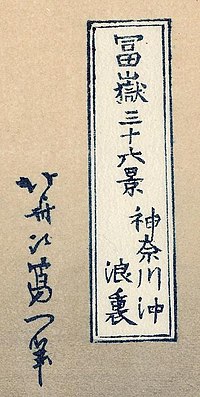
The Great Wave of Kanagawa has two inscriptions. The title of the series is written in the upper-left corner within a rectangular frame, which reads: "冨嶽三十六景/神奈川沖/浪裏" Fugaku Sanjūrokkei / Kanagawa oki / nami ura, meaning "Thirty-six views of Mount Fuji / On the high seas in Kanagawa / Under the wave". The inscription to the left of the box bears the artist's signature: 北斎改爲一筆 Hokusai aratame Iitsu hitsu which reads as "(painting) from the brush of Hokusai, who changed his name to Iitsu". Due to his humble origins, Hokusai had no surname; his first nickname Katsushika was derived from the region he came from. Throughout his career, Hokusai used over 30 names and never started a new cycle of work without changing his name, sometimes leaving his name to his students.
Depth and Perspective
Depth and perspective (uki-e) work in The Great Wave off Kanagawa stand out, with a strong contrast between background and foreground. Two great masses dominate the visual space: the violence of the great wave contrasts with the serenity of the empty background, evoking the yin and yang symbol. Man, powerless, struggles between the two, which may be a reference to Buddhism (in which man-made things are ephemeral), as represented by the boats being swept away by the giant wave, and Shintoism (in which nature is omnipotent).
Creation
Hokusai faced numerous challenges during the composition of The Great Wave off Kanagawa. In 1826, whilst in his sixties, he suffered financial difficulty, and in 1827 apparently suffered a serious health problem, probably a stroke. His wife died the following year, and in 1829 he had to rescue his grandson from financial problems, a situation that pushed Hokusai into poverty. Despite sending his grandson to the countryside with his father in 1830, the financial ramifications continued for several years, during which time he was working on Thirty-six Views of Mount Fuji. Cartwright and Nakamura (2009) interpret Hokusai's tribulations as the source of the series' powerful and innovative imagery. Hokusai's goal for the series appears to have been depicting the contrast between the sacred Mount Fuji and secular life.
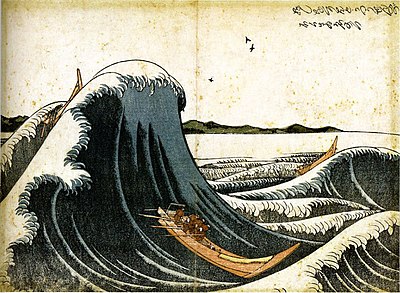
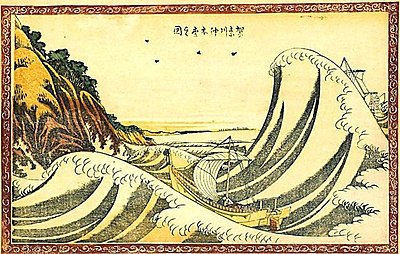
After several years of work and other drawings, Hokusai arrived at the final design for The Great Wave off Kanagawa in late 1831. Two similar works from around 30 years before the publication of The Great Wave can be considered forerunners: Kanagawa-oki Honmoku no Zu and Oshiokuri Hato Tsusen no Zu, both of which depict a boat (a sailing boat in the former, and a rowing boat in the latter) in the midst of a storm and at the base of a great wave that threatens to engulf them. The Great Wave off Kanagawa demonstrates Hokusai's drawing skill. The print, though simple in appearance to the viewer, is the result of a lengthy process of methodical reflection. Hokusai established the foundations of this method in his 1812 book Quick Lessons in Simplified Drawing, in which he explains that any object can be drawn using the relationship between the circle and the square: "The book consists of showing the technique of drawing using only a ruler and a compass ... This method starts with a line and the most naturally obtained proportion". He continues in the book's preface: "All forms have their own dimensions which we must respect ... It must not be forgotten that such things belong to a universe whose harmony we must not break".
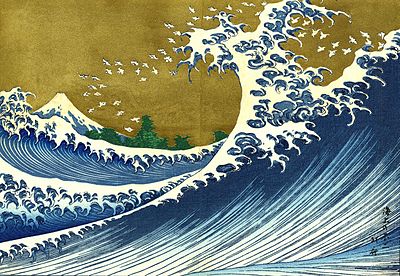
Hokusai returned to the image of The Great Wave a few years later when he produced Kaijo no Fuji for the second volume of One Hundred Views of Fuji. This print features the same relationship between the wave and the mountain, and the same burst of foam. There are no humans or boats in the latter image, and the wave fragments coincide with the flight of birds. While the wave in The Great Wave moves in the opposite direction of the Japanese reading – from right to left – the wave and birds in Kaijo no Fuji move in unison.